
Canada Puremium Case Study: Product-Led SEO and GEO for an 81-Product Canadian Health Brand in Three Languages
How PLANSALE structured Canada Puremium (加国甄选) so every product page, FAQ, article and llms.txt answers the questions overseas buyers and AI assistants ask before buying Canadian supplements.
Client: Canada Puremium (加国甄选), Toronto
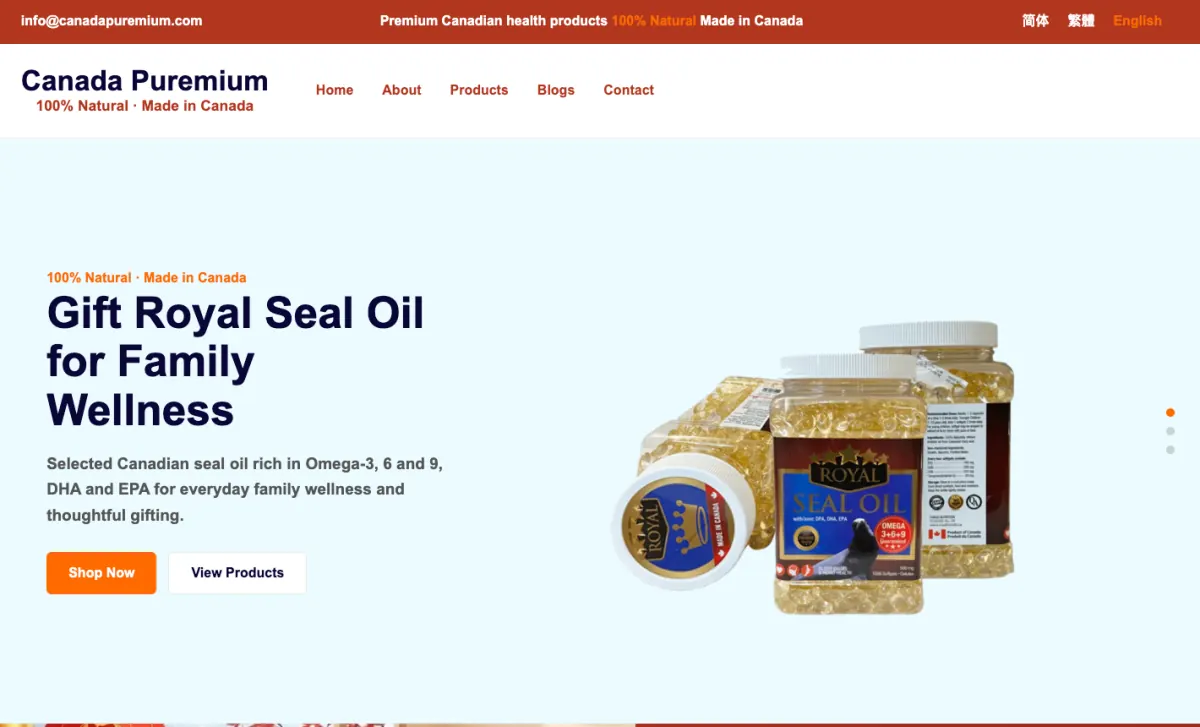
Canada Puremium (加国甄选) is a Toronto-based store for Canadian natural health products. It sells 81 products and ships directly to mainland China, Hong Kong, Taiwan and several Southeast Asian countries. Almost none of its buyers can walk into a store, read a label or ask a pharmacist. They search, read and ask AI assistants, then decide whether to trust a stranger overseas.
That makes product content the entire sales floor. This case study shows how PLANSALE structured the site so that each product, question and article gives search engines and AI assistants clear, consistent facts to quote.
The Problem: Buyers Ask Questions Before They Search for Products
Someone looking for seal oil does not only type “seal oil”. They ask which brand is good, how to check the NPN, what the shipping to China costs, whether duties apply, and whether it is safe alongside medication. A catalogue of product cards answers none of that. Those questions are where the search traffic, and the trust, actually sit.
So the site was organized around the questions, not just around the products:
- Is it authentic, and how do I verify it?
- How do I order, pay and ship from Canada?
- What does shipping cost to my country, and what about duties?
- What happens after delivery if something is wrong?
- Is it safe for me, in pregnancy, or with medication?
Product Pages Built as Structured Answers
Each product page is written for both a shopper and a crawler. Taking the seal oil page as the reference example:
- A search-led title and description. The title combines the product, the nutrients people search for (Omega-3, EPA, DHA, DPA) and the brand. The description states the format, dose per capsule and what the product is for.
- A clear page structure. A product details section, a usage section, an FAQ section and links to related products, under a single H1.
- Product structured data with real attributes. Beyond name, image and price, the markup lists spec, form, main ingredient, origin, NPN, per-serving content, shelf life and storage as named properties, with an Offer and availability.
- A product-specific FAQ. The seal oil page carries seven questions, starting with what it contains, and the same questions are marked up as FAQPage data.
- Breadcrumbs. BreadcrumbList markup ties each product to its category.
- Label-first wording. Doses and ingredients are tied to what the bottle says, rather than claims the page cannot back up.
The same pattern repeats across the catalogue, so a buyer or an AI system landing on any of the 81 products finds the same kind of information in the same place.
Categories That Match How People Shop
Products are grouped the way buyers think about them: premium tonics, metabolic support, cardiovascular, men’s health, general nutrition, bones and joints, eye health, immunity, propolis, beauty and skincare, and family and gift sets. Each category groups related products and gives search engines a clean topical hierarchy, while the “More products” block on each page links buyers sideways to the next likely choice.
Three Languages, 339 Indexable URLs
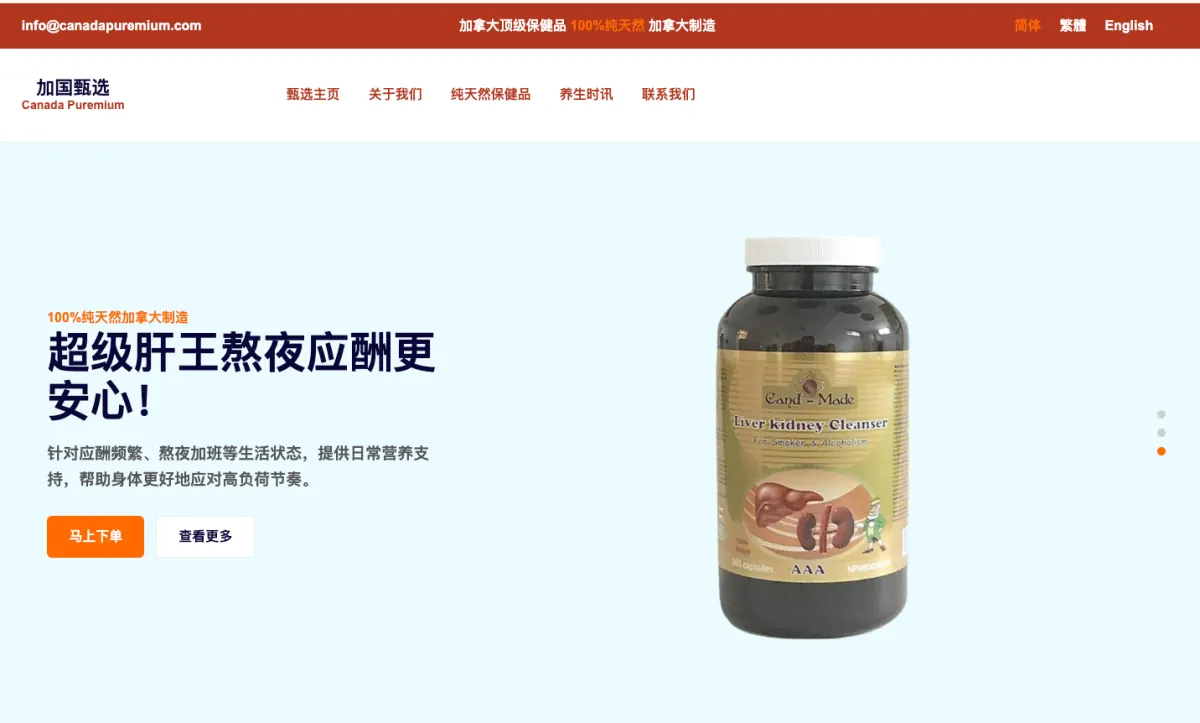
The site is published in Simplified Chinese (the default), Traditional Chinese (/zh-hant) and English (/en). Each version has the full 81-product catalogue and 24 articles, which comes to 339 URLs in the sitemap.
- Each language has its own canonical URL.
- The sitemap declares the relationships with hreflang for zh-Hans, zh-Hant, en and x-default.
- The language switcher sits in the top bar of every page, so a visitor can move between versions without hunting for it.
Buyers in Hong Kong, Taiwan and mainland China search with different characters and vocabulary, and an English version serves the wider market and AI assistants answering in English. One translated copy would not serve them all.
Articles That Answer the Comparison Questions
The 24 articles per language are not filler. They are written for the comparison stage, the point where a buyer is choosing between products. The seal oil buying guide is the model:
- A direct answer first: how to judge whether a seal oil is good.
- Seven buying criteria, including checking the NPN first, then comparing daily EPA, DHA and DPA intake, price per capsule, formula, shelf life and who the product suits.
- Pros and cons, a price comparison calculated by daily cost, and advice for self use, gifts and children.
- What to watch when buying at a warehouse club, pharmacy or online.
- How to take it, plus side effects and contraindications.
- References and an editorial note.
Articles carry BlogPosting markup with reviewer and citation fields, FAQPage data and a table of contents. The aim is that the article is the best available answer to the question, so search engines surface it and AI assistants can quote it with its sources.
Trust and Commerce Pages Are Part of the SEO
For an overseas buyer, shipping and returns are the product too. So the site publishes them as real pages rather than footnotes:
- FAQ page. Grouped into product and authenticity, ordering and payment, shipping, after-sales, and use and safety, and marked up as FAQPage data.
- Shipping page. Lists the destination countries, the rate structure, worked examples and a calculator.
- About and contact pages. With Organization data carrying the Toronto address and contact point.
The GEO Layer: llms.txt, Consistent Facts and Clean Crawling
Generative engine optimization means giving AI systems one reliable place to learn what the business is and what it sells. Canada Puremium publishes:
- An llms.txt file. A compact plain-language summary of the business: who it is, where it is, the number of products, the ship-to countries, the shipping rates, the key pages and every product with a one-line description and URL.
- Consistent facts across pages. Shipping rates, countries, language versions and the “supplement, not a drug” position match between llms.txt, the shipping page and the FAQ, so an AI answer does not have to choose between conflicting figures.
- Standard crawl files. A robots.txt and a full multilingual sitemap with hreflang annotations.
Writing Carefully in a Regulated Category
Health products sit in a sensitive category for both search engines and regulators. The structure above supports a careful tone: products are presented as nutritional supplements, ingredient and dose details point back to the label, the FAQ addresses pregnancy and medication safety, and the content is marked as informational rather than medical advice. A site that is open about limits earns more trust than one that promises outcomes, and it is easier to keep accurate as the catalogue grows.
What We Measure, and What We Don’t Claim
This case study does not publish traffic or revenue figures. The signals worth tracking for a site like this are impressions and clicks in Google Search Console by language and by product, which questions trigger FAQ and rich results, whether AI assistants name and link the site when asked about Canadian supplements, and inquiries and orders arriving by email. These move over months, and they depend on product quality, price and fulfilment as much as on the website.
What Is Next
A strong structure shows where the next gains are. The English version carries shorter metadata than the Chinese version, so extending its titles and descriptions to the same depth is an obvious next step. Newer articles can be linked more tightly from the product pages they support, and the FAQ coverage can be extended to the products that have fewer questions today.
FAQ
What did PLANSALE do for Canada Puremium?
PLANSALE structured the site around buyer questions and product facts. The work covered product page templates with structured data, a three-language catalogue with hreflang, comparison-stage articles, FAQ and shipping pages, and a GEO layer with llms.txt and consistent facts.
Why does an ecommerce store need GEO as well as SEO?
Buyers increasingly ask AI assistants which brand to buy or how to check a product. Those answers draw on clear, consistent, extractable facts. SEO earns the ranking, and GEO makes sure the facts an AI system finds about your business are accurate and complete.
What structured data does each product page use?
Product pages carry Product data with named attributes and an Offer, BreadcrumbList data for the category path, FAQPage data for the product questions, and sitewide Organization and WebSite data.
Why publish the site in three languages?
Buyers in mainland China, Hong Kong, Taiwan and English-speaking markets search with different words and characters. Separate language versions, each with its own canonical URL and hreflang, let each audience find the page written for them.
Can PLANSALE build a similar system for another business?
Yes. PLANSALE builds product-led SEO and GEO for ecommerce, wellness and specialty brands. Start with PLANSALE projects or explore AI search optimization.
Conclusion
Canada Puremium shows that for a product catalogue, SEO and GEO are mostly a matter of structure: one clear pattern repeated across every product, honest answers to the questions buyers actually ask, and a single consistent set of facts that search engines and AI assistants can both rely on.
If your catalogue is large, multilingual or sold to buyers who cannot touch the product first, explore PLANSALE services or see more projects.
What did PLANSALE do for Canada Puremium?
PLANSALE structured the site around buyer questions and product facts. The work covered product page templates with structured data, a three-language catalogue with hreflang, comparison-stage articles, FAQ and shipping pages, and a GEO layer with llms.txt and consistent facts.
Why does an ecommerce store need GEO as well as SEO?
Buyers increasingly ask AI assistants which brand to buy or how to check a product. Those answers draw on clear, consistent, extractable facts. SEO earns the ranking, and GEO makes sure the facts an AI system finds about your business are accurate and complete.
What structured data does each product page use?
Product pages carry Product data with named attributes and an Offer, BreadcrumbList data for the category path, FAQPage data for the product questions, and sitewide Organization and WebSite data.
Why publish the site in three languages?
Buyers in mainland China, Hong Kong, Taiwan and English-speaking markets search with different words and characters. Separate language versions, each with its own canonical URL and hreflang, let each audience find the page written for them.
Can PLANSALE build a similar system for another business?
Yes. PLANSALE builds product-led SEO and GEO for ecommerce, wellness and specialty brands. Start with PLANSALE projects or explore AI search optimization.